

An Evening Stroll
- join me for a wildlife-spotting walk up the track

Life has been pretty quiet here lately, and while I certainly don’t see that as being a bad thing, it doesn’t really make for the most inspiring writing opportunities! It is, however, the life I have chosen for myself, and the older I get, the more I realise that life isn’t about the big events: it’s all the little day-to-day things that happen in between.
I took some extra time off work during the Easter holidays and spent a fair chunk of it out in the garden. I planted my potatoes, sowed carrots and parsnips, peas and beans, cucumbers and courgettes. I also processed a lot of branches in the electric wood chipper my husband and son gave me for my birthday last month, and have put several loads into the chicken run and made a start on the path down the middle of the polytunnel and the ones between the vegetable beds.
Now that the days have noticeably lengthened, sitting by the fire playing board games in the evenings has been replaced by walks up the track. Would you like to join us? I recommend wearing your wellies: even though the weather has been much drier this last week, the ground is still pretty saturated and boggy in places.
Are you ready? Let’s go!
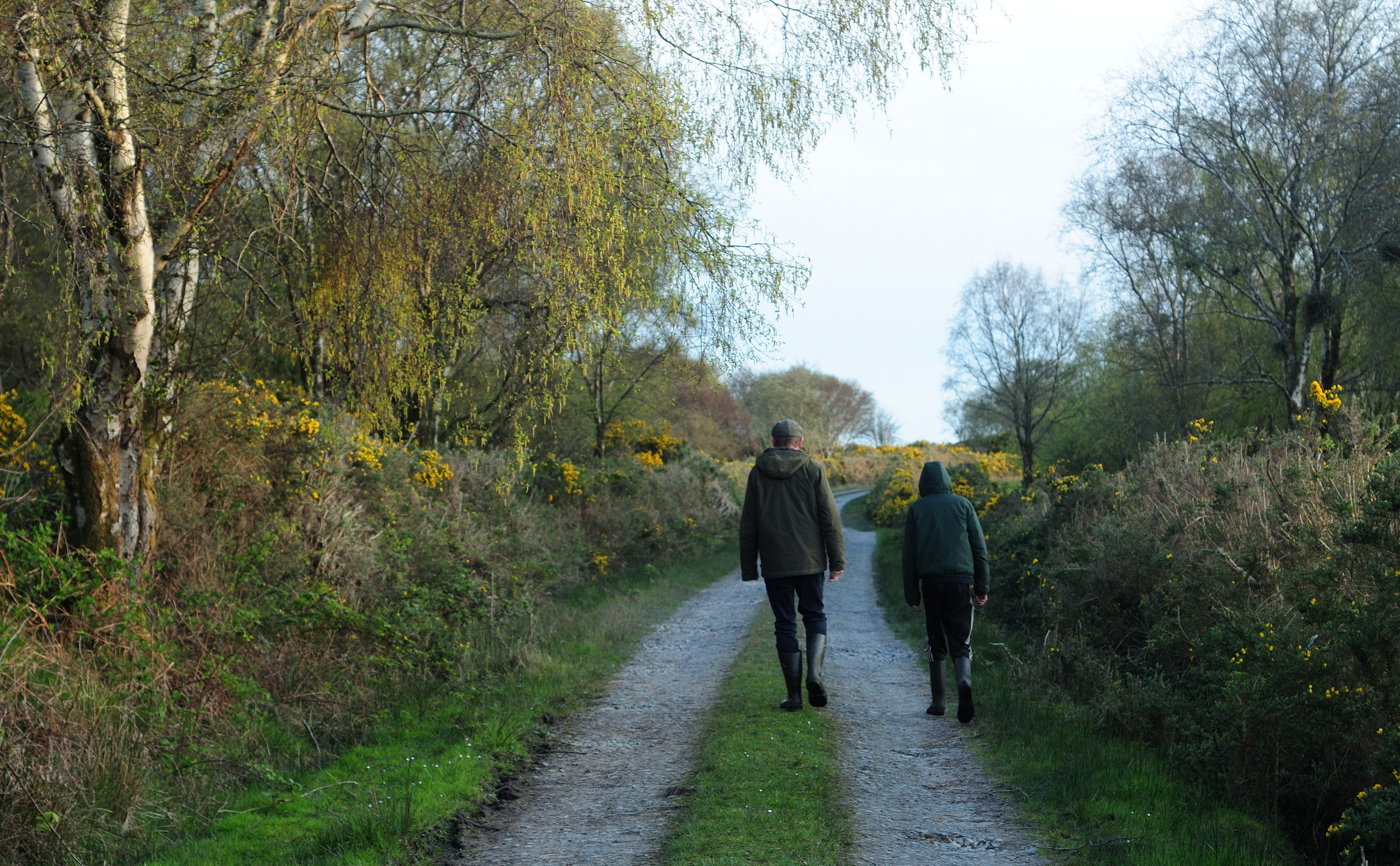
It’s still light when we set out. A robin is singing loudly somewhere, and a blackbird alarm-calls as we pass the oak tree. I have our bat detector with me; by the time we’re returning home it will be dusk and there should be a few bats flitting about.
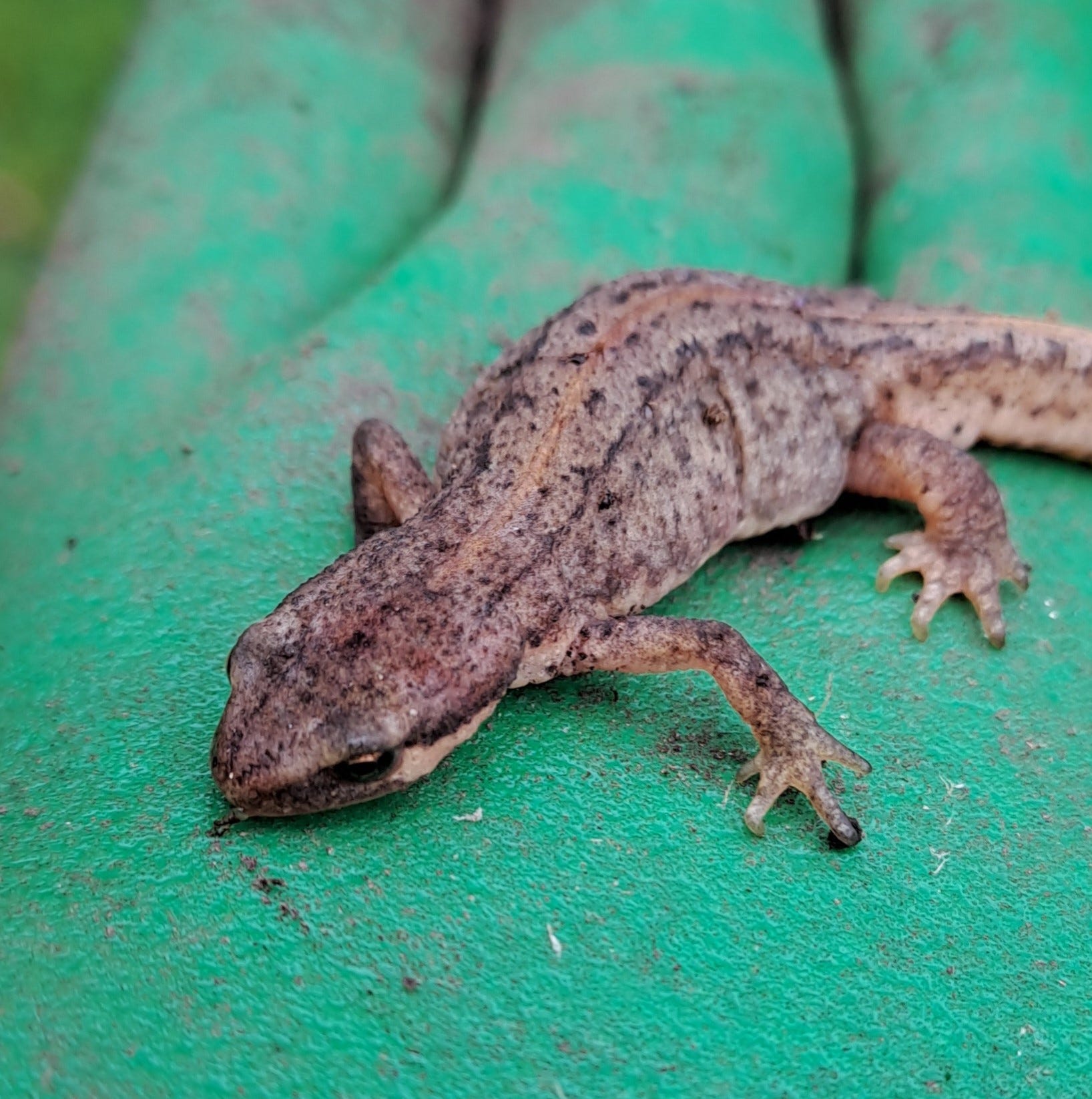
There’s a ditch that runs along the right-hand side of the track for a while. We stop and have a look in a deep bit, in case any newts are visible. No luck this time, they must all be hiding in the mud or have headed back out into the wilderness. Like toads, newts are only really aquatic during the breeding season when they can be seen in ponds and ditches. They spend most of the rest of the year in damp rather than wet places, and hibernate through the winter.
A bit further along, at the edge of the ditch, some Common Butterwort (Pinguicula vulgaris) is growing. This is a carnivorous plant, a specialist of acidic heaths and bogs, with a rosette of yellow-green leaves that exude a sticky fluid that attracts insects. The insect gets stuck to the leaf, which curls around it and slowly digests it. In a month or two it will produce a couple of purple flowers at the top of its stem. I can’t help feeling the plant is a bit mean: “Hey insects, come and pollinate my flowers, and in return I will EAT YOU!” The name Butterwort comes from an old belief that rubbing the leaves on cows’ udders would protect against evil spirits and bad butter.
A few pairs of geese are hanging out in the field with the cows: a mix of Greylag (Anser anser) and Canada (Branta canadensis). They move further away as we pass. A heron squawks as it flies overhead on its way to roost in the trees.
The track curves round to the right at the yard, and we cross the cattle grid. Tufts of nettle, bramble, and ribwort plantain leaves are starting to poke through between the metal bars.

On we go towards Rabbit Mountain (it’s more of a hummock than a mountain, really.) There are sheep in the field here with young lambs bouncing about, and there, in amongst the clumps of reeds, we spot a rabbit busily nibbling away, ears twitching occasionally. We watch it for a minute before continuing on our way. The hawthorns and elders here have greened up nicely over the last few days, and the blackthorn blossom I wrote about last week is almost all passed. The first bluebells are starting to flower in the verges.
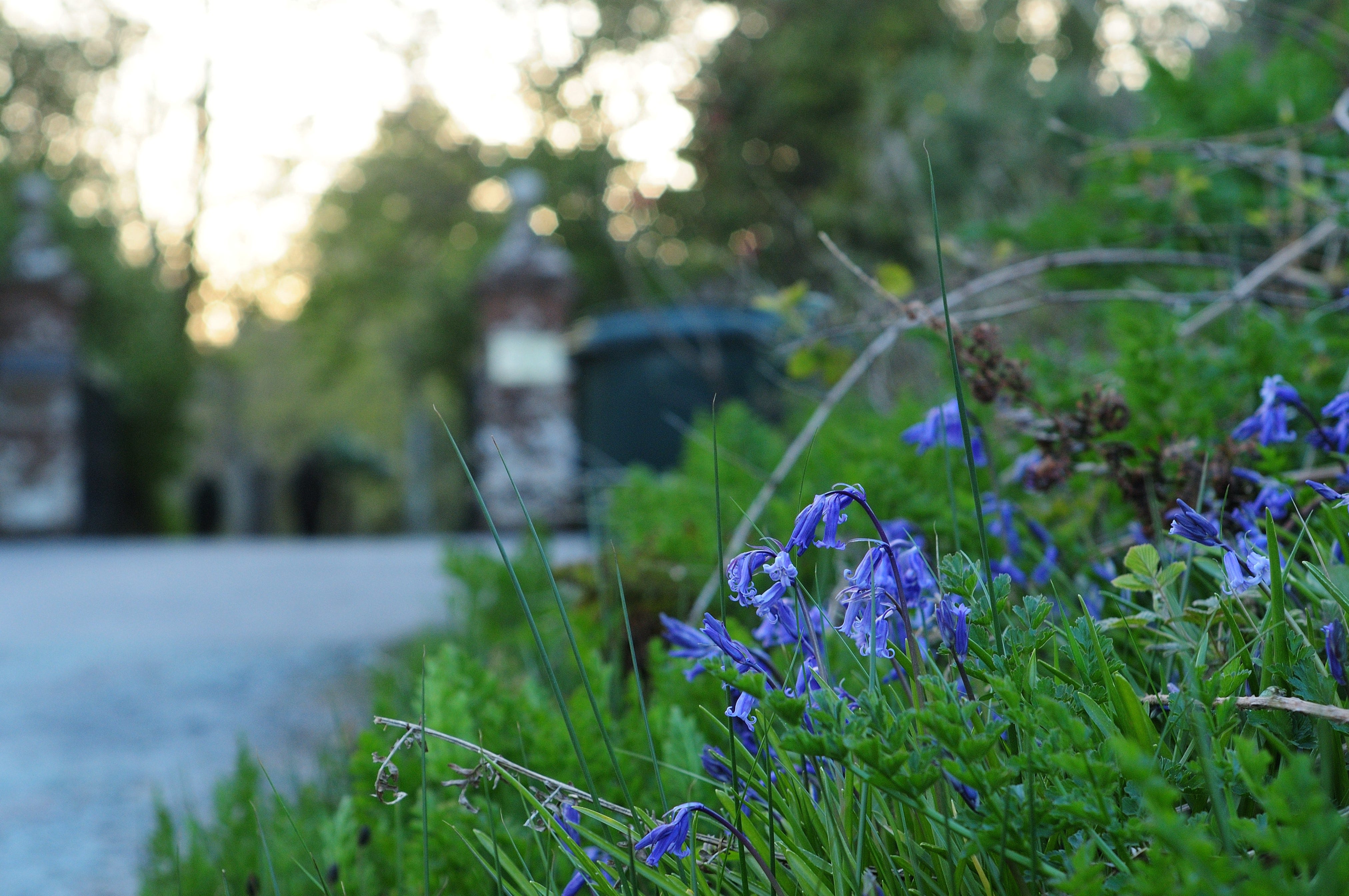
We cross the “main road” and pass between the stone gateposts into The Gardens. The birdsong is loud in the trees above us here; everyone is singing their hearts out before heading off to bed.
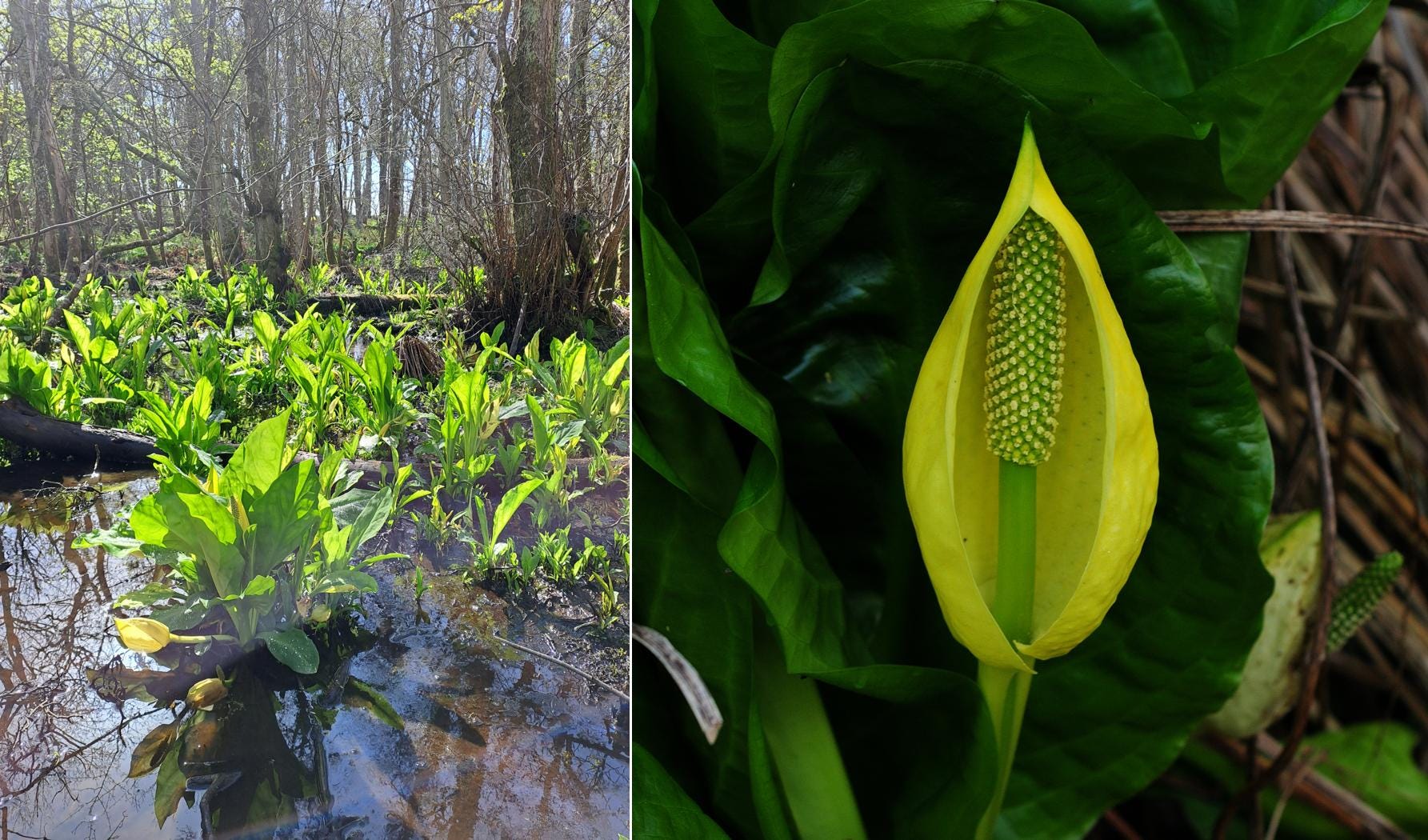
One of the first things we spot is a Skunk Cabbage (Lysichiton americanus) in flower. This is a non-native species, and we all spent a couple of hours with the Conservation Volunteers last week, decapitating flowers in an area of wet woodland. Skunk Cabbage was introduced to Britain from North America in 1901, as an ornamental garden plant. It soon escaped though and has become problematic, outcompeting native plants and blocking waterways.
I think in the future we will have to re-think our relationship with so-called “Invasive Non-Native Species”. Often they only become a problem due to our land management practices, and as our climate changes, so will the species able to survive and thrive in our landscapes.
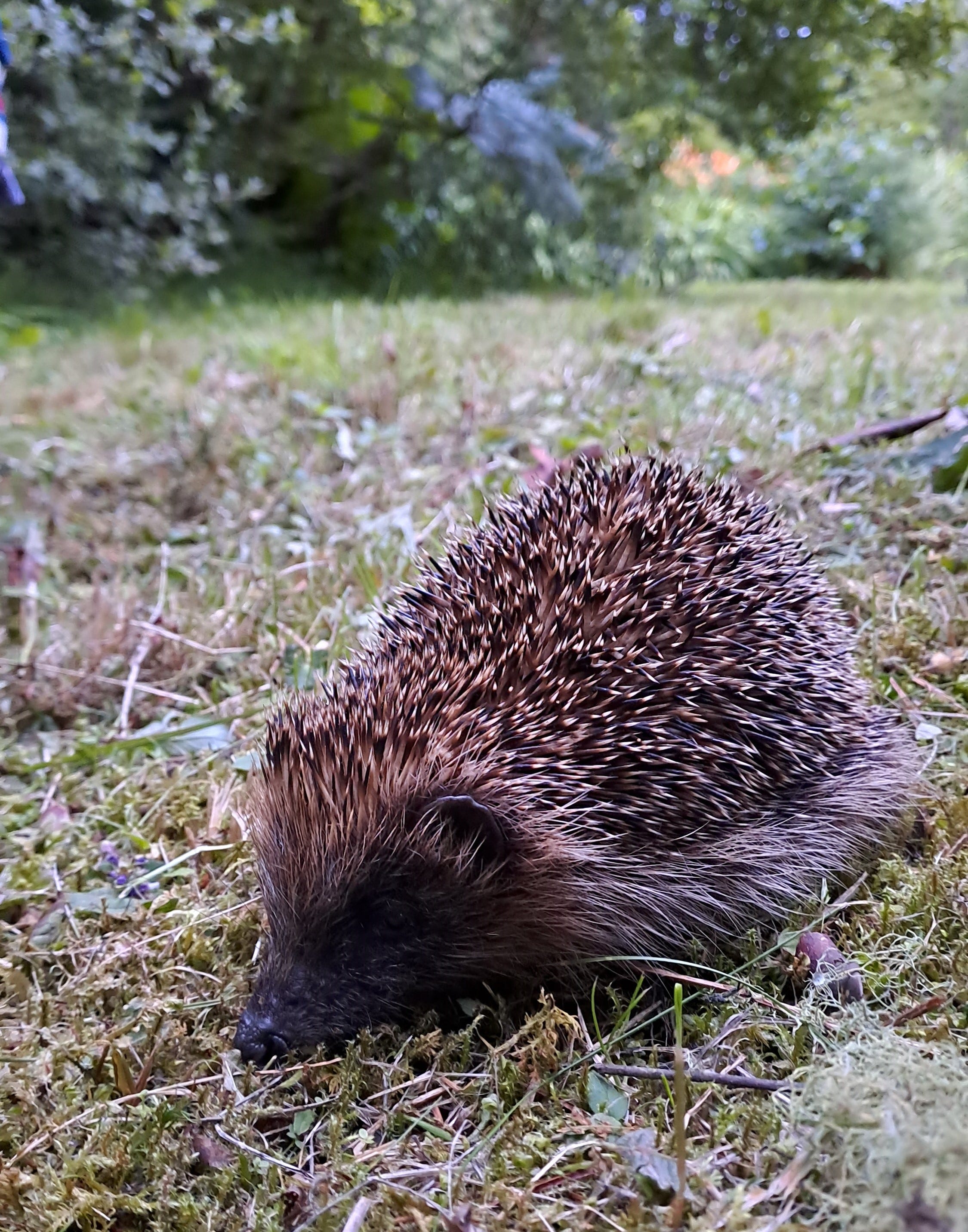
My son spots movement out of the corner of his eye, and we all turn to look – and listen. It’s a pair of hedgehogs (Erinaceus europaeus). One of them is circling the other, making snuffling noises. I guess it is probably a male, and the other one is a female. We leave them in peace to enjoy their night!
Speaking of invasive, non-native species, while hedgehogs are native to Britain, they were introduced to this island in the 1980s by a well-meaning resident who wanted to control the slugs and snails in their garden. They’ve done very well, but unfortunately also eat the eggs of ground-nesting birds, so there are definitely some people who would be happier if they weren’t here.
We turn right past the Katsura tree – which is now in full leaf – and head into the shady gloom of the woodland path towards the village hall. The Gunnera manicata has had a growth spurt recently, and soft green Beech leaves are starting to unfurl above our heads. I’ll come back sometime soon and pick some to make this year’s batch of Beech Leaf Noyau.
At the village hall we have a look in the playing field just behind it: four rabbits here, including one very small one. If you’re starting to wonder if the main purpose of these evening walks is to look for rabbits, then yes, you are correct! They’re my favourite animal, and no day is complete without seeing at least one.
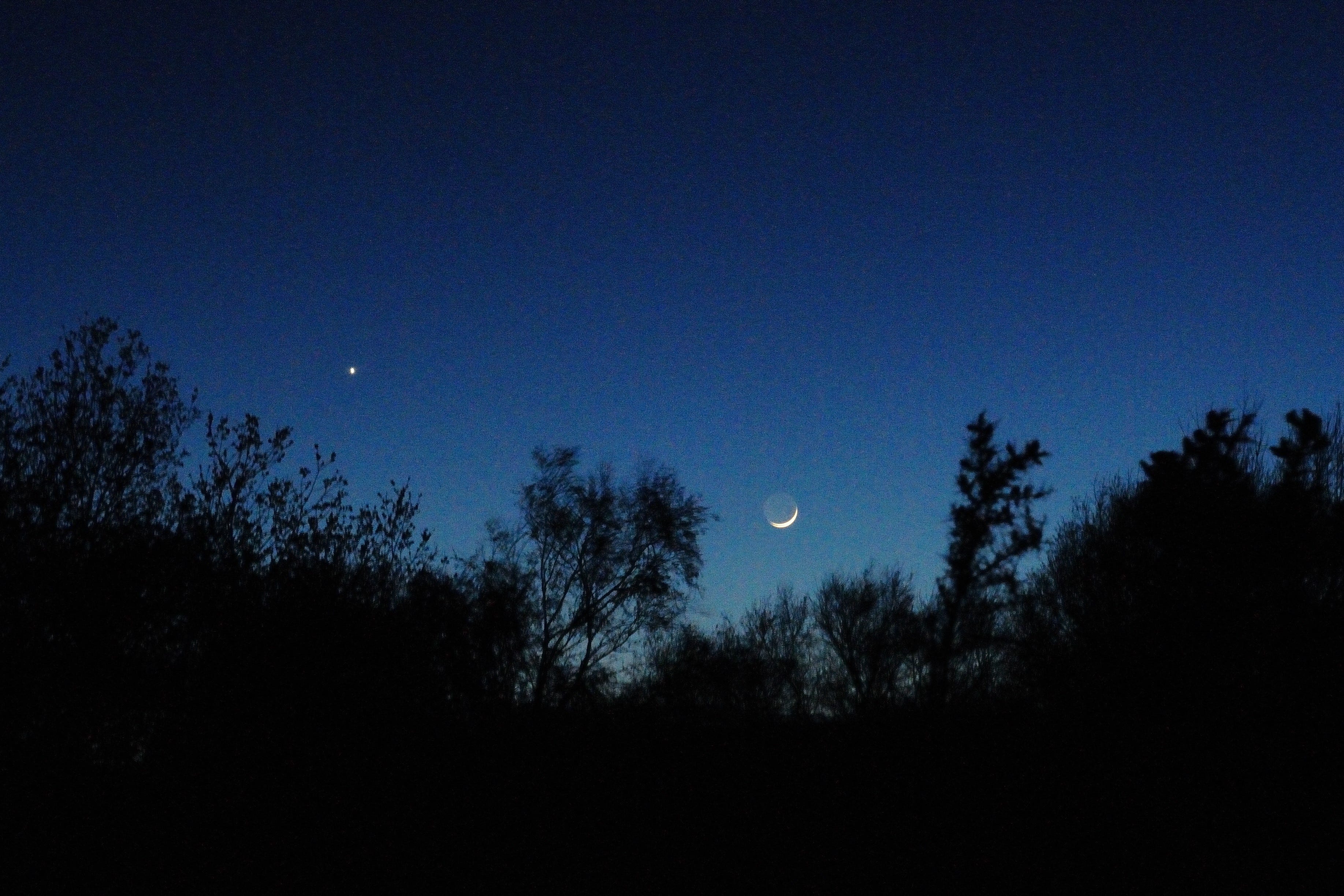
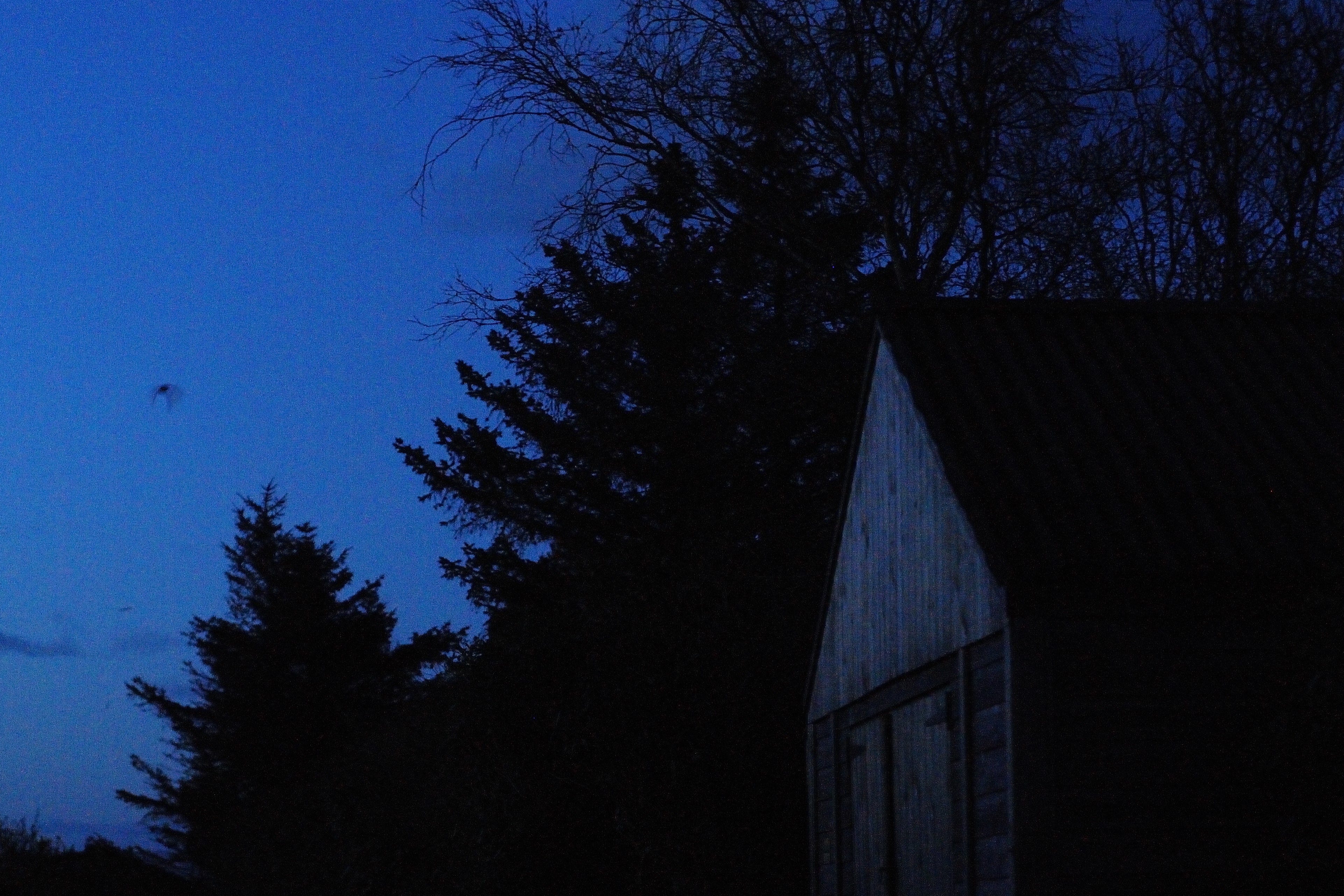
This is the furthest point of our usual walking route, and we now head back along the main road to the top of the track. It’s getting dark now, and the moon is a skinny crescent hanging almost horizontally in the western sky. As we approach the cattle grid again the bat detector, which had been dangling from my wrist emitting a soft background static noise, starts to click and chatter. We all spot them at the same time: three or four little Pipistrelle bats, and they swoop and flutter around our heads, their leathery wings flapping so fast they’re a blur.
Four different species of bat are found here: Common and Soprano Pipistrelle, Daubenton’s, and Brown Long-Eared. When they’re flying past at speed and you can’t get a good look at them they can be identified by the frequency and pattern of their calls, using a bat detector. Common Pipistrelles echolocate at a frequency of 45kHz, while Sopranos are 55kHz. There’s a bit of overlap between the two though, so I tend to have the detector set at 50kHz. So I know these are Pipistrelles flying around us, but my detector isn’t fancy enough to narrow it down to species, unlike a more modern digital one could.
Bats can eat thousands of insects in just one night. Despite my fondness for moths, I do also really like seeing bats, even if they are a major predator of moths. Pipistrelles tend to feed on flies though, and at the moment I think they’re probably feeding on the ones hatching out of all the cow poop around this area.
The bats escort us down the track towards home, darting around our heads, the detector picking up their ultrasonic calls. It’s almost fully dark when we arrive back at the front door a few minutes later. I don’t tend to take my camera with me on these walks, so I popped inside and grabbed it before heading back out to take a couple of quick pictures of the moon and the bats.
Thanks for joining us on our walk – I hope you enjoyed yourself. Next week we have an Austrian exchange student staying with us, so I might not have time to write anything to share next Friday.
I’m going to leave you with a song written and performed by my husband that mentions going for a walk along a country track :-)
Have a good weekend.
Cat x
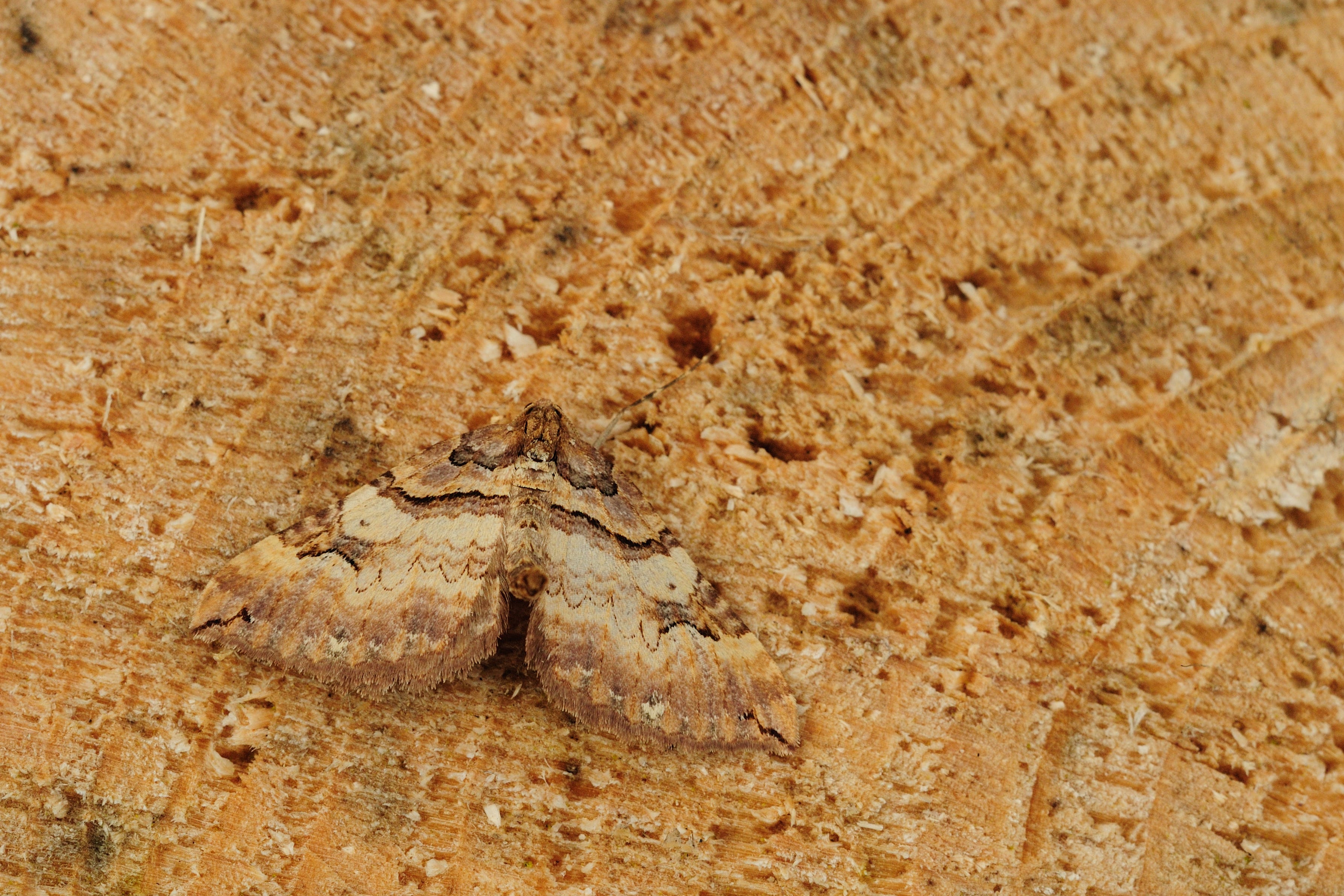
Moth of the Week: Shoulder Stripe (Anticlea badiata)
This geometrid is one of my favourite springtime moths (Ha! I think I say that about them all, don’t I?!) It has very pretty striped wings, which is where the common name comes from. They are found throughout most of Britain, and are a regular visitor to my trap each year. Larval foodplants are Dog rose and other wild rose species, of which I have plenty in my garden.
Posts here are always going to be free, but if you like what I write and/or find it useful, I’ve added a ko-fi button below if you want to show your appreciation. Thank you to everyone who has already contributed! xx
I love this cat. It is so warm and informative. It is such a pleasure to read something written by somebody so richly and deeply immersed in such a powerful passion and love of live. Thank you so much for sharing your work.
A hedgehog! One I've never encountered on the trail. Or a porcupine. Nice tune!!