

Glorious Greens
- sloths, moths and turacos

The last week has been a mix of sunshine and showers: perfect weather for plant growth. Everything is lush and green, and I have (almost) forgotten the long winter of brown mud...
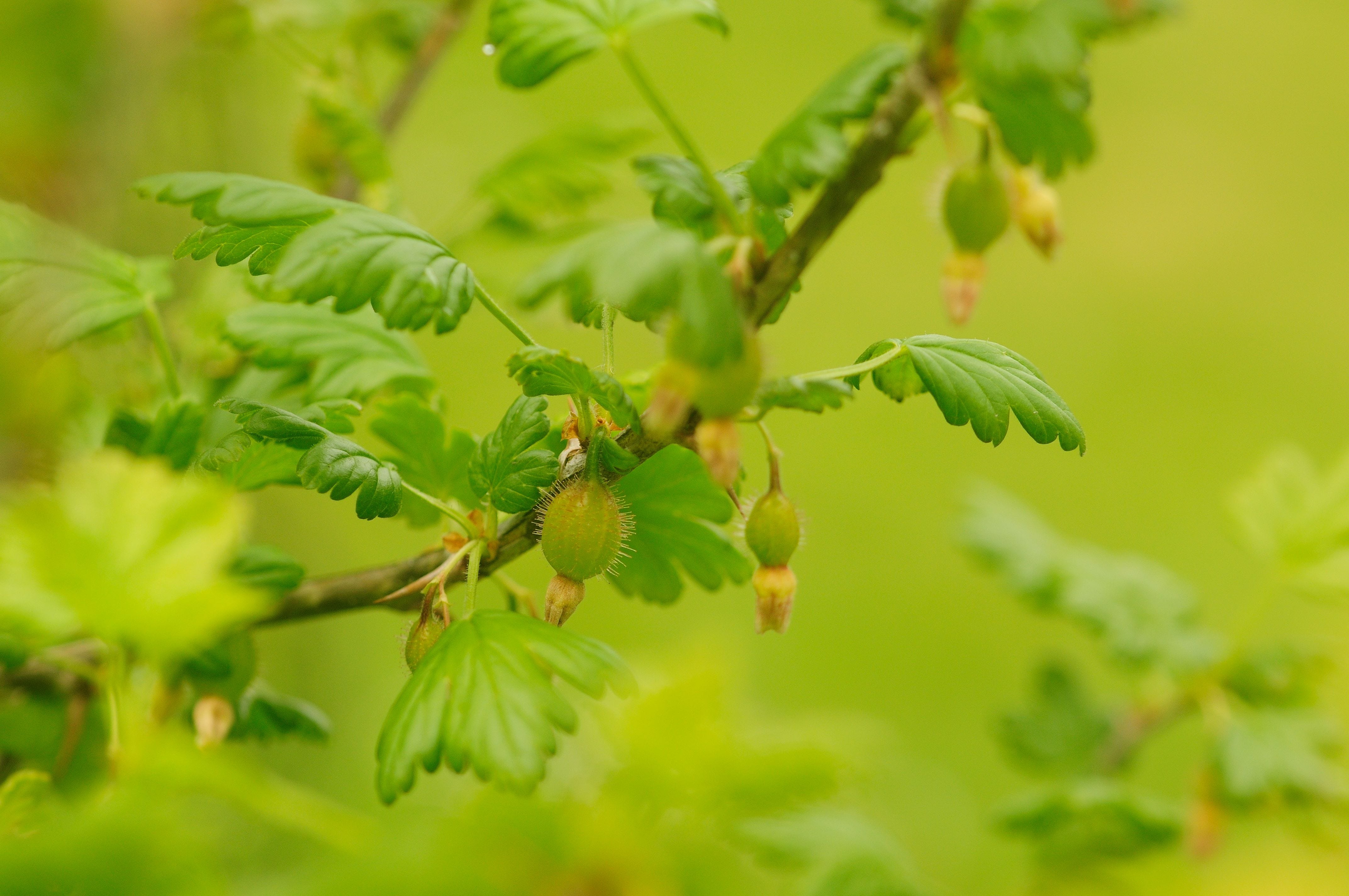
I remember reading a few years ago that the human eye can detect more shades of green than of any other colour, and looking around the garden, it’s easy to believe. The freshly emerged leaves on the oak tree are a bronze-tinged sort of green; the gooseberries and unripe strawberries are a zingy lime-green; the foxglove leaves in the wilder corners of the garden are a furry, silvery-grey green. Then there’s the glossy dark green of the straggly cotoneaster spreading down the rocky slope: it’s the current hang-out of the newly fledged family of house sparrows, their cheeping a constant background soundtrack to work in the garden.
It makes perfect sense that our eyes would be attuned to all these subtle differences in shades of green. We evolved in a green leafy world, foraging for food, so there would have been definite advantages in being able to detect slight differences and identify whether something was food, medicine, or poison.
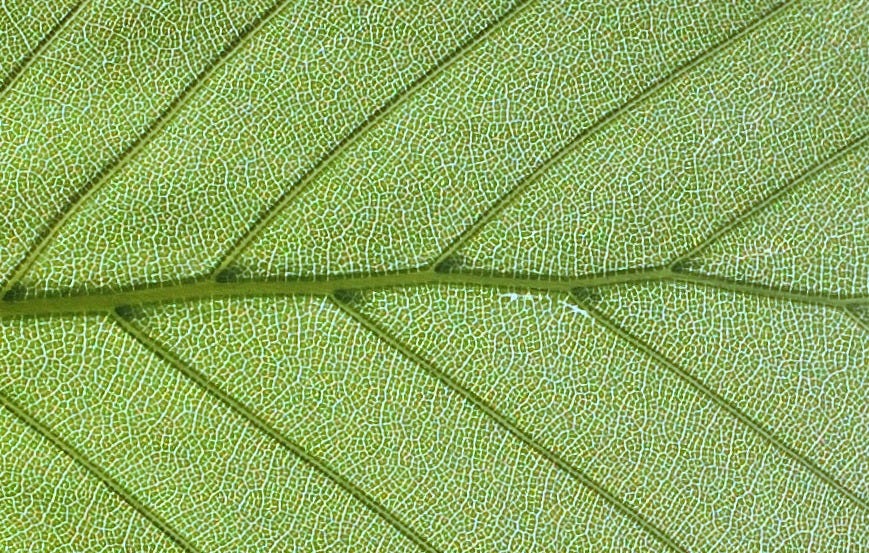
Most of the green in the world around us comes from plants. Plants are green because of the presence of chlorophyll, found in chloroplasts in plant cells. Chlorophyll plays a vital role in photosynthesis, which is the process by which plants convert light into chemical energy. Chlorophyll absorbs light from the blue and red parts of the spectrum and reflects green light, which is why it appears green to us.
It can be a bit more difficult for other living things to produce green colours. In fact, many of the birds, fish and reptiles that look green to us actually use a combination of yellow and blue pigments, and microscopic skin structures.
There are some amazing green creatures though, so let’s have a look at a few.
Sloths are often cited as being the only green mammals, but this isn’t strictly true as the sloths themselves aren’t actually green. Instead, the structure of sloth hair is unique: it is covered in tiny microcracks which can trap moisture and debris, creating the perfect environment for several species of algae and fungi to grow in. Some of these species are found nowhere else in the world! The algae gives the sloth a greenish tinge and this, along with their slow movements, helps to camouflage them from predators.
Sloth fur also provides the perfect habitat for different species of sloth moths. These moths are found exclusively on sloth fur, and different species can coexist happily on the same individual sloth.
The larvae of these moths feed on sloth poop so, when the sloth descends to the ground once a week to poop, moths will crawl from the sloth’s fur onto the poop to lay their eggs1. The larvae develop happily there and, once they have pupated into adult moths, they fly up into the canopy to find a sloth to live on and continue the cycle.
So, since we’re on the subject of moths now... This whole post is possibly just an excuse to share some photos of green butterflies and moths, so shall we begin?!
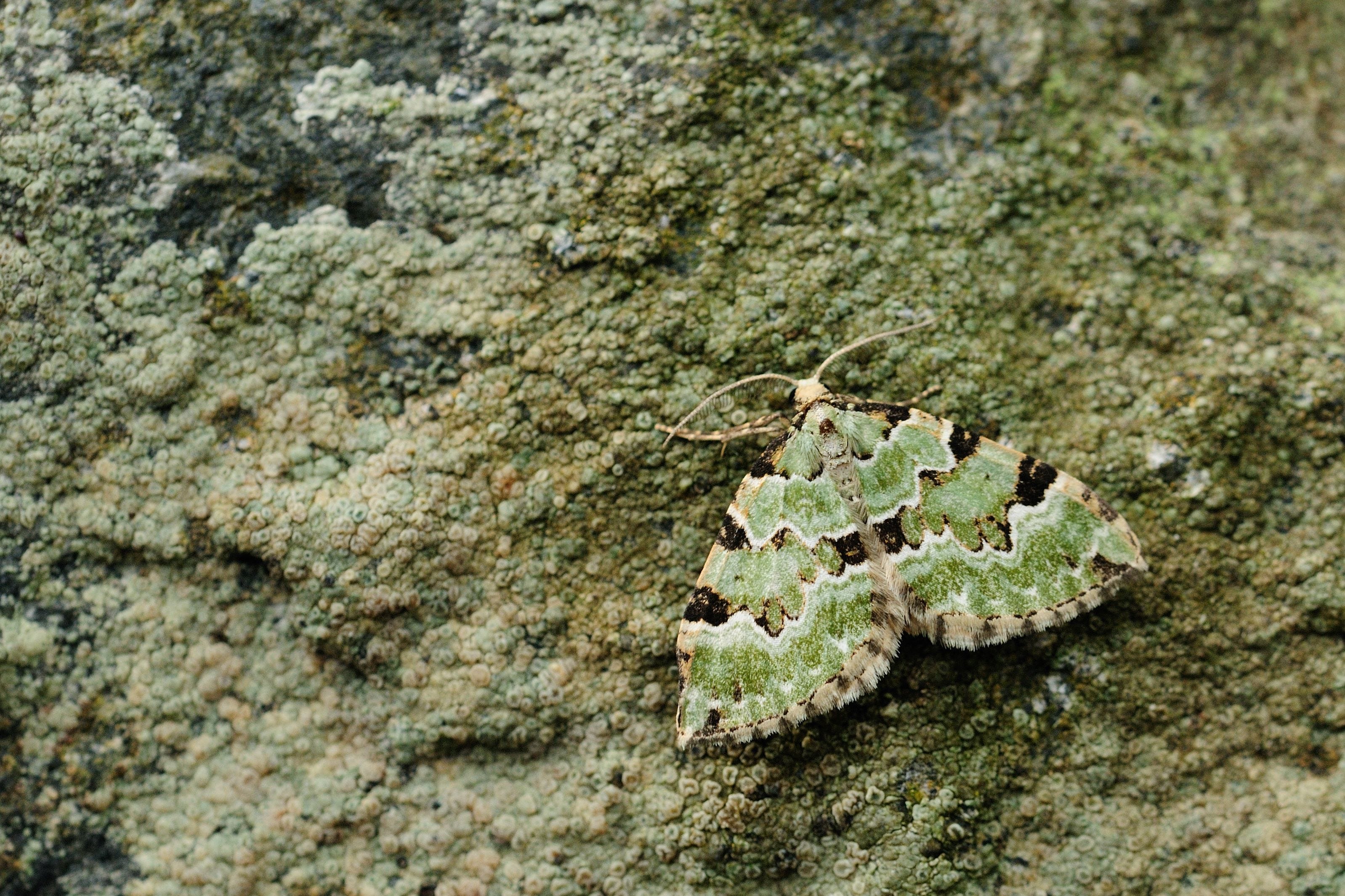
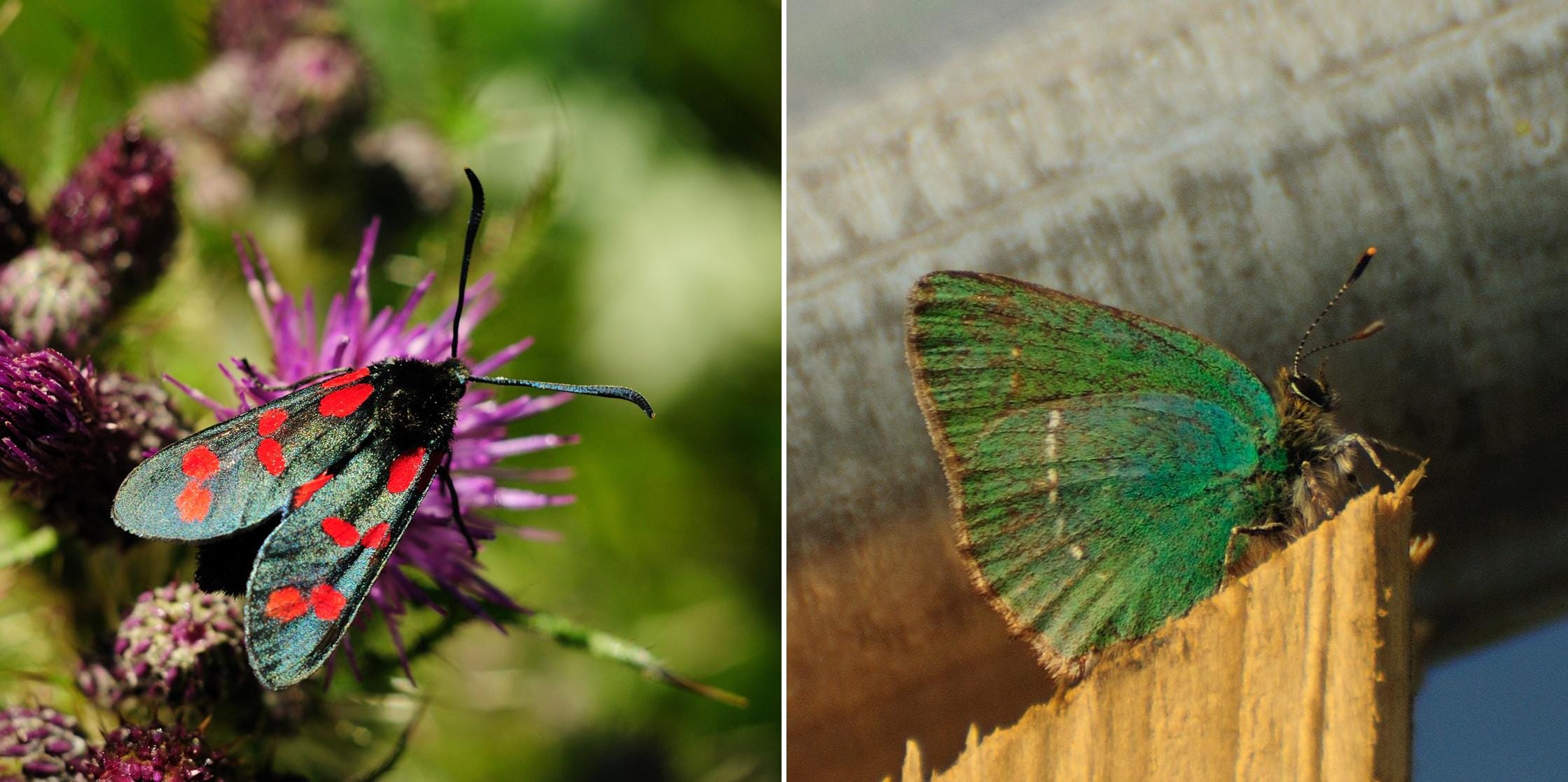
There are many different species of butterflies and moths that make use of green colouration to camouflage themselves from predators. There are two different ways of doing this: green pigmentation, or structural colouration.
Let’s start with pigmentation.
Pigments create colour by absorbing certain wavelengths of light. In butterfly and moth wings, these pigments are generally solid and are deposited on the wing scales.
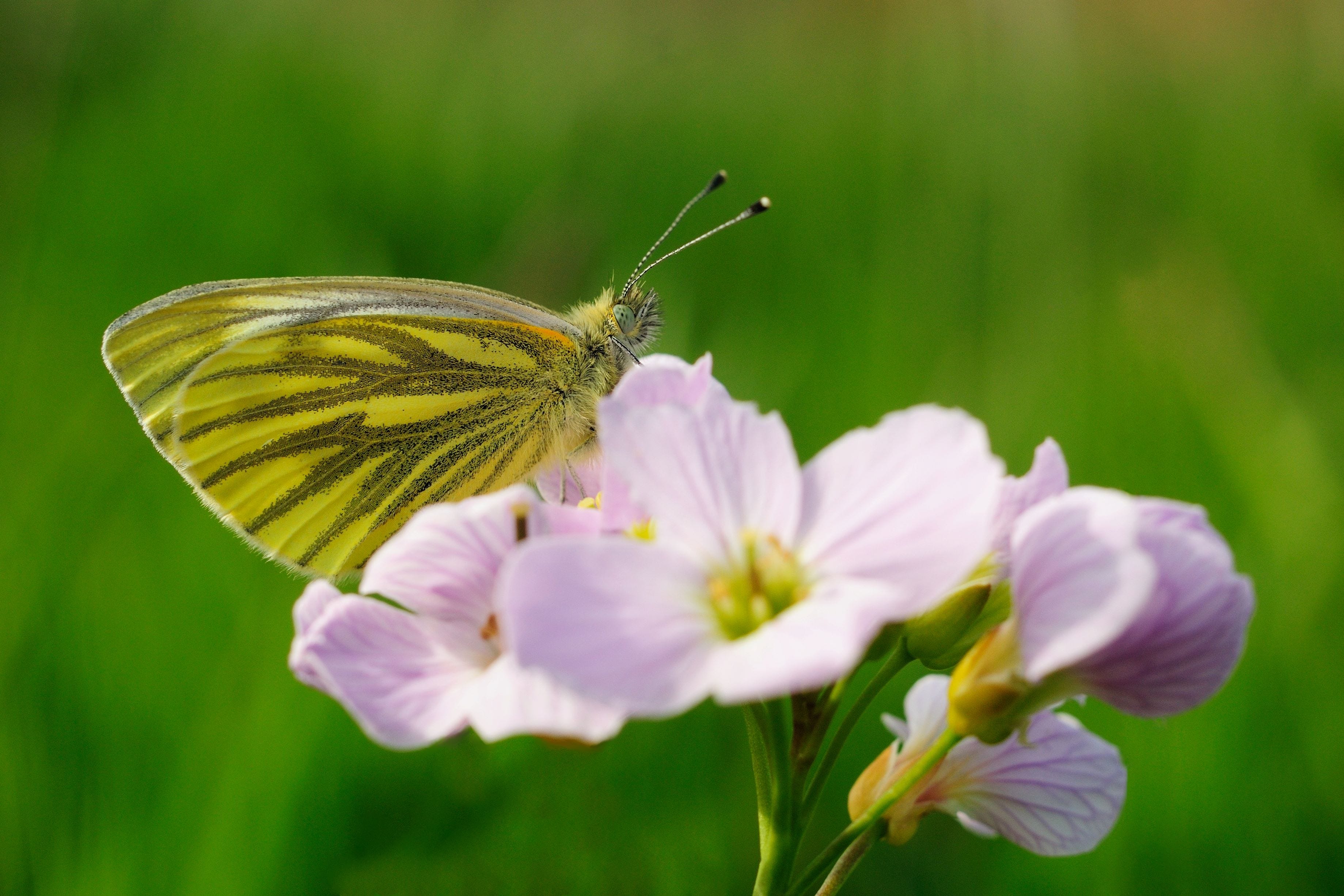
Some species which look green don’t actually have any green pigment, though. The Green-Veined White below doesn’t have green veins: they are made up of black and yellow scales, which from a distance look green.
In the Emerald moths, such as the Light Emerald shown top left below, the colour comes from a single green pigment called geoverdin, which is thought to be a derivative of chlorophyll, consumed during the caterpillar stage.2 This pigment is thought to be much less stable than the green pigment found in some Noctuid moths, which is why Emeralds can often look very pale as their pigment degrades3 (rather than just looking pale because some of the scales have been rubbed off).
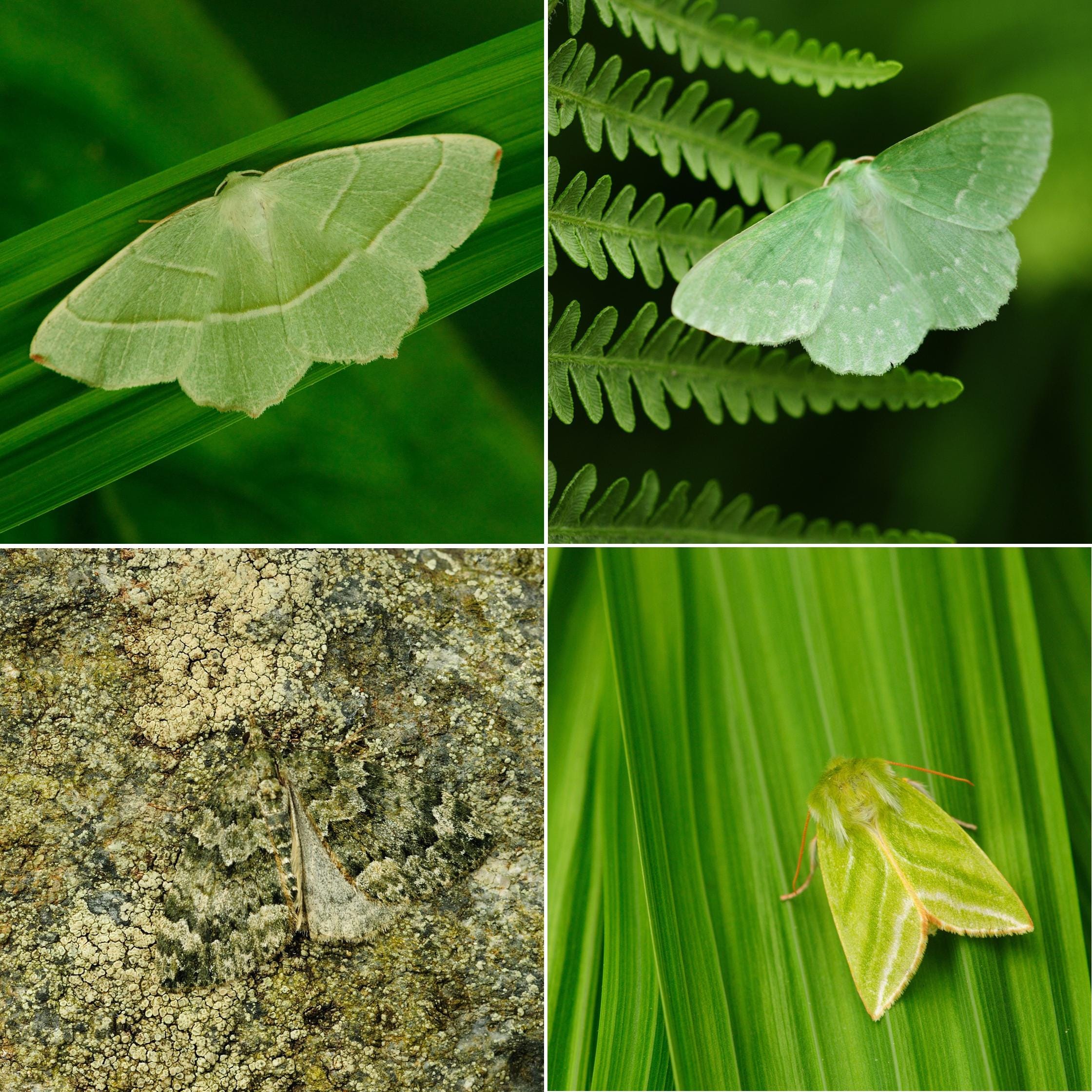
A study from 2023 found a new mechanism of butterfly wing colouration in two distantly related species, Siproeta stelenes and Philaethria diatonica: liquid pigments within the wing membrane. You can read the paper here if you want to know more about this.
The other option for green colouring in butterflies and moths doesn’t come from pigments, but instead from tiny physical structures that selectively reflect light to create a vivid array of colours known as “structural colours”. These microscopic structures are around 100 μm long and adorn the wing surfaces.
“These wing scales are covered in intricate, repeating nanostructures, such as a honeycomb-like lattice or layers of chitin. When white light hits these structures, the light waves are scattered and interfered with, similar to how oil on water creates a rainbow sheen. This constructive interference amplifies specific wavelengths, causing only the green light to reflect strongly back to the viewer’s eye. This mechanism is why many green butterflies appear iridescent, with their color shifting slightly depending on the viewing angle.”4
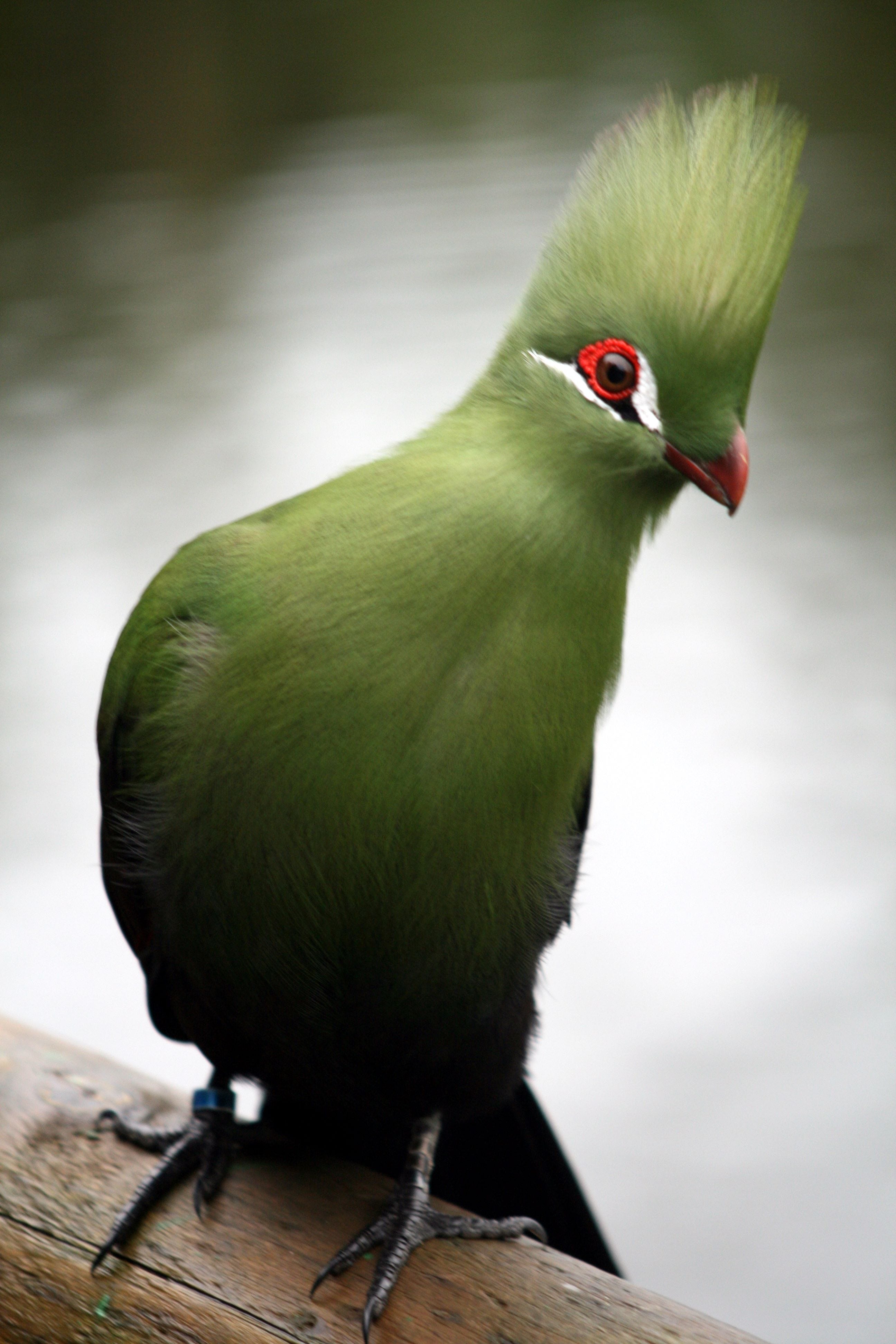
And finally… Turacos are a family of birds, consisting of 23 species in 5 genera, found solely in Africa. They live in a range of wooded habitats including montane forest, savannah and suburban gardens. They feed on a wide variety of fruits, foraging amongst the foliage in groups of up to a dozen birds.
The young of most species of land birds are fed a high-protein diet of invertebrates during the crucial growth phase between hatching and independence. Unusually, turaco chicks are fed a diet of mostly fruit, supplemented by just the occasional invertebrate (mostly snails).
Another unusual feature of turacos is to do with their feather pigments. Turaco feathers contain two vivid pigments, both of which are copper compounds: turacoverdin, a green pigment, and turacin, a red one.
Turacoverdin produces the rich green body feathers found in 14 species of turaco. Neither it or turacin is found in any other living bird species. In other birds with green feathers, the colours are produced either by refracting light with specialised feather structures that produce iridescence, or a combination of pigments and structural colours. For example, the green colour of some parrots is caused by a yellow pigment overlying blue-reflecting structures on the feathers.5
It takes a young turaco about a year to develop full adult colouration, and it is thought this may be due to the difficulty of acquiring enough copper to produce the pigment. It has been estimated that a turaco would need to eat about 20kg of fruit to obtain enough copper to colour its plumage.6
So, what’s your favourite green creature? I’m torn between saying ALL the green moths, or the kakapo, a flightless parrot found in New Zealand. Let me know in the comments if you want!
Cat x
Moth of the Week: What do you mean, you want another one? You’ll just have to enjoy all the ones I’ve already shared pictures of above :-)
Posts here are always going to be available to read for free. However, if you like what I write and want to contribute financially without committing to a paid subscription, I’ve added a ko-fi button below if you would like to show your appreciation. Thank you to everyone who has already contributed! xx
How many times is it possible to use the word “poop” in one sentence?!
https://biologyinsights.com/are-there-green-butterflies-how-they-get-their-color/
https://academy.allaboutbirds.org/how-birds-make-colorful-feathers/
From “The Encyclopedia of Birds” (2009) ed. Christopher Perrins. Oxford University Press. p320: Turacos
We have lots of green birds here in western Mexico: Orange-fronted parakeets, Lilac-crowned parrots, and a little further south you can see Military Macaws. However, my favorite local green bird is the Russet-crowned Motmot. https://birdsoftheworld.org/bow/species/rucmot1/cur/introduction?lang=es
I love the long tick-tock tail that looks like a tiny pendulum from a grandfather clock.
I can't think of any green moths off the top of my head, but we do have this nifty green butterfly that loves to eat fruit: Mariposa Malaquita: https://en.wikipedia.org/wiki/Siproeta_stelenes
I saw turacos and knew that you'd be discussing pigments! I saw a pair of turacos in Kenya last month and I was outsizedly excited because finally! Actually green birds! I am using a lot of exclamation points here, and it is because I really was that excited! On another note, sloth moths. New idea for a Halloween costume... a sloth... and a moth. Stay tuned for how quickly my partner votes that one down. This was an amazing post, Cat, as usual.