
Moths Matter!
(And they're not all brown and boring...)

If you have found me on here through my Instagram page, you will probably be aware that I quite like moths. Now that “mothing season” has kicked off again, I thought it was only right that I shared a bit about these winged creatures that I am slightly obsessed with...
Moths, along with butterflies, make up the order Lepidoptera. Worldwide, there are estimated to be around 160,000 species of moth, of which approximately 2500 occur in the British Isles. They are split into two groups: macromoths (big ones) and micromoths (little ones). There are a few anomalies though: for example the macromoth Least Black Arches (Nola confusalis) is much smaller than the Small Magpie (Eurrhypara hortulata, a micromoth).
Moths are found in many different habitats including woodland, gardens, moorland, mountains and the coast. While many people think of them as being dull and brown, they exhibit a wide variety of colours and shapes. They are also not all nocturnal; in fact in the UK there are more species of day-flying moths than there are of butterflies.
I had had a few encounters with moths before I got properly “into” them, the most memorable of which occurred while I was a seasonal ranger at St Abb’s Head NNR, on the east coast of Scotland, during a university summer holiday. I was cycling up the hill after work to the lighthouse buildings I was living in, when I spotted something out of the corner of my eye, hovering by a flower. A hummingbird? In Scotland?! Surely not! A closer look revealed it was a Hummingbird Hawkmoth (Macroglossum stellatarum), which in my opinion was just as exciting, if not quite so exotic!
I have been monitoring the moths in my island garden using a homemade trap for over a decade now. I first got into trapping when a couple of volunteers from the UK charity Butterfly Conservation visited the island, and asked if they could set up traps in different gardens. I volunteered my garden, and was amazed at the variety of moths that turned up in the trap during the night. Big ones, small ones, furry ones, brightly coloured ones, camouflaged ones... I was hooked!
I looked into buying my own moth trap, but they were out of my budget at the time so instead I decided to make my own. I modelled it on a Robinson-style trap and it is basically a bucket with a cardboard flange and an upturned lightshade in the top like a funnel. There is a lightbulb in the top, which the moths are attracted to. For the first couple of years I just used a normal energy-saving lightbulb and managed to attract over 100 species. My husband then bought me the electronics and fittings so I could use a mercury vapour (MV) bulb, which really increased my catches! MV bulbs give off ultraviolet light, making them attractive to moths. They fly into the trap and because of the shape of the entrance, they find it difficult to escape so instead just sit around inside waiting to be identified, recorded and released the following morning. The trap is filled with cardboard egg boxes, which mimic the nooks and crannies the moths would hide in in their natural environment.


When it comes to identification, I have a couple of well-thumbed favourite books: “The Field Guide to the Moths of Great Britain and Ireland” by Waring, Townsend and Lewington, and “The Field Guide to the Micro-moths of Great Britain and Ireland” by Sterling, Parsons and Lewington. Some moths are pretty straightforward to identify, and some even wear a name badge: for example the Silver Y (Autographa gamma) has a silver “Y” shape on each forewing. Other moths, however, are more challenging to get an exact identification, and in some cases require genital dissection! That is not something I do as I would prefer to have a living unknown moth rather than a dead named one.
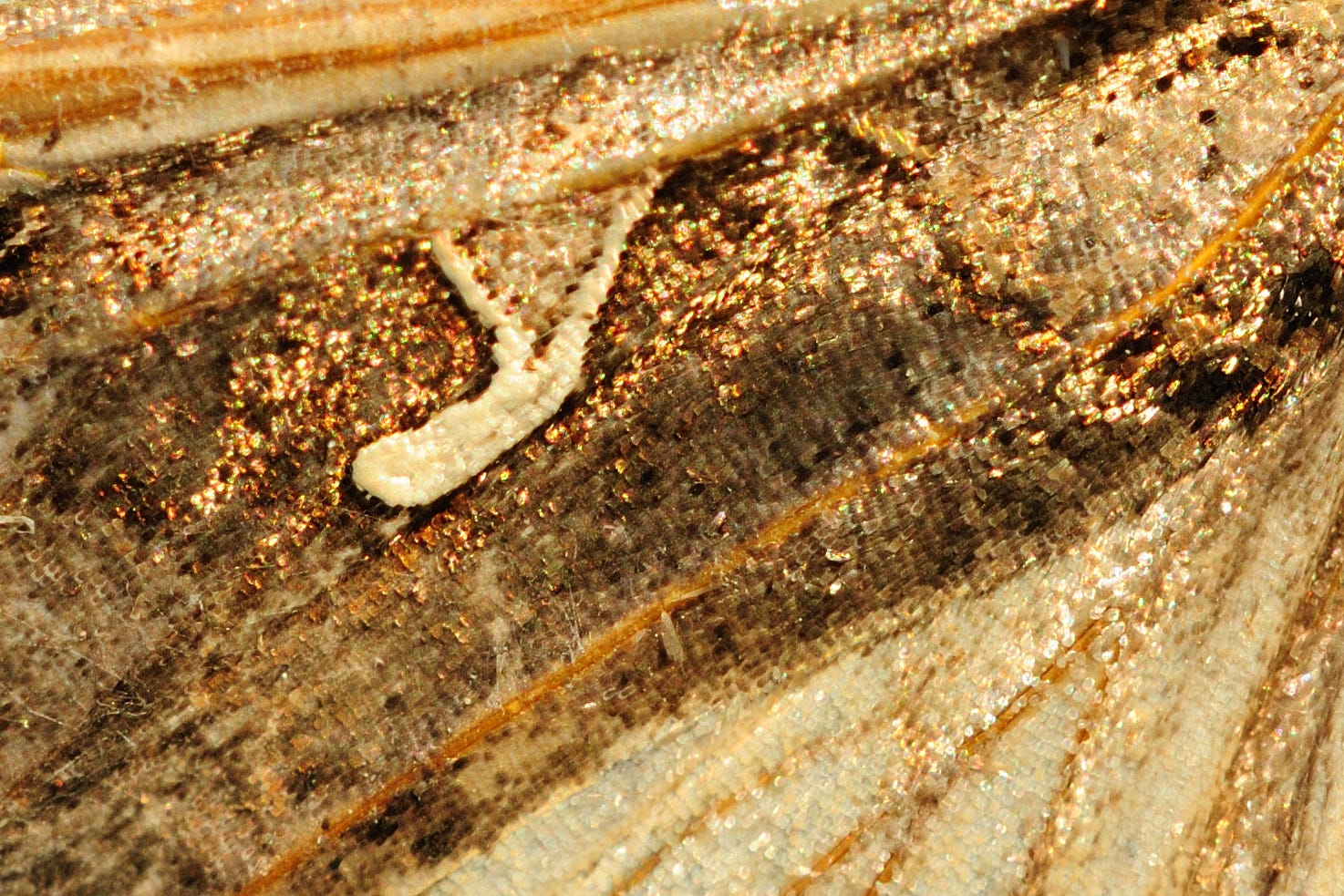
I send all my results to my County Moth Recorder, who checks them and submits them to a national database (the National Moth Recording Scheme, or NMRS). This allows longterm changes in numbers and distribution to be tracked. Moths are very sensitive to changes in the environment and can be useful as indicator species, alerting us to problems caused by, for example, pollution, pesticide use, or climate change. In order to draw any accurate conclusions about changes in numbers or distribution, it is essential to have enough data.
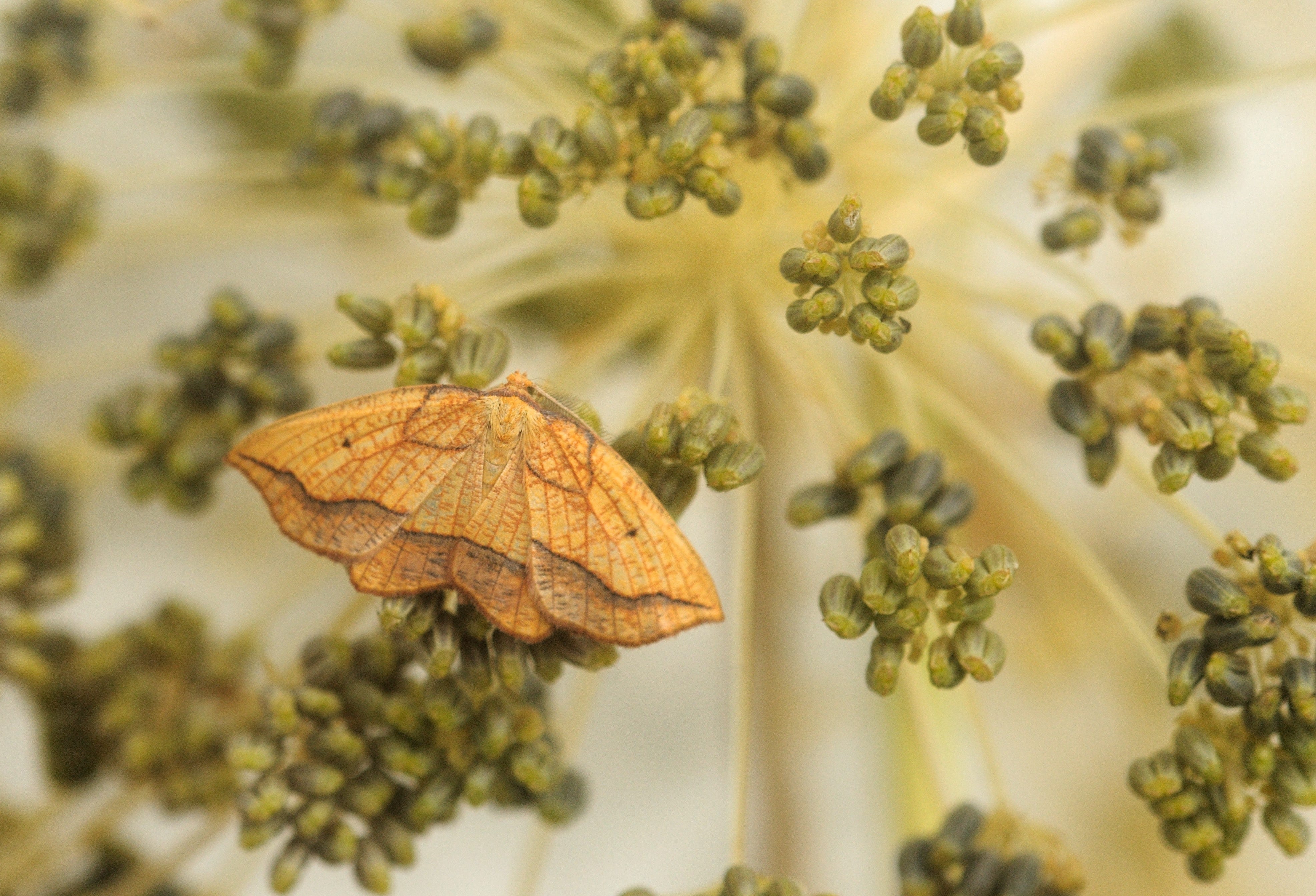
Over the years I’ve added a few new species to the county list. Some of these have been big, beautiful ones like the Lilac Beauty (Apeira syringaria) while others have been slightly less-spectacular-looking micro-moths, which are very easy to overlook. Last summer I rescued a tiny moth from a water butt in my garden. I identified it as Lampronia luzella, then didn’t think anything else of it until I submitted my results to the county recorder, who got back in touch and asked for a photo to confirm it. Not only was it the first record for the county since 1980, there had only been one other Scottish record in the last five years. The caterpillars have never been documented so nobody knows what the larval foodplant is, but it’s thought it could be bramble, of which there is plenty in my garden!


According to Butterfly Conservation, 65 species of moth have gone extinct in the UK in the last century. Of the remainder, around two thirds of species are declining. But why does this matter? They’re just moths, aren’t they? Actually, moths are a hugely important but often underappreciated part of our ecosystem.
Their role as pollinators is often overlooked, with much more attention being given to bees which are major pollinators of many commercially important agricultural crops.
It has been known for a while that moths pollinate a range of wild flowers, making them important for the health and diversity of ecosystems in general. However, a 2015 study at a farm in Yorkshire found that nocturnal moths visited many more plants than was previously thought, including several food crops such as peas and brassicas. By analysing the pollen the moths were carrying, it was also suggested that some of them were transporting pollen for several hundred metres.
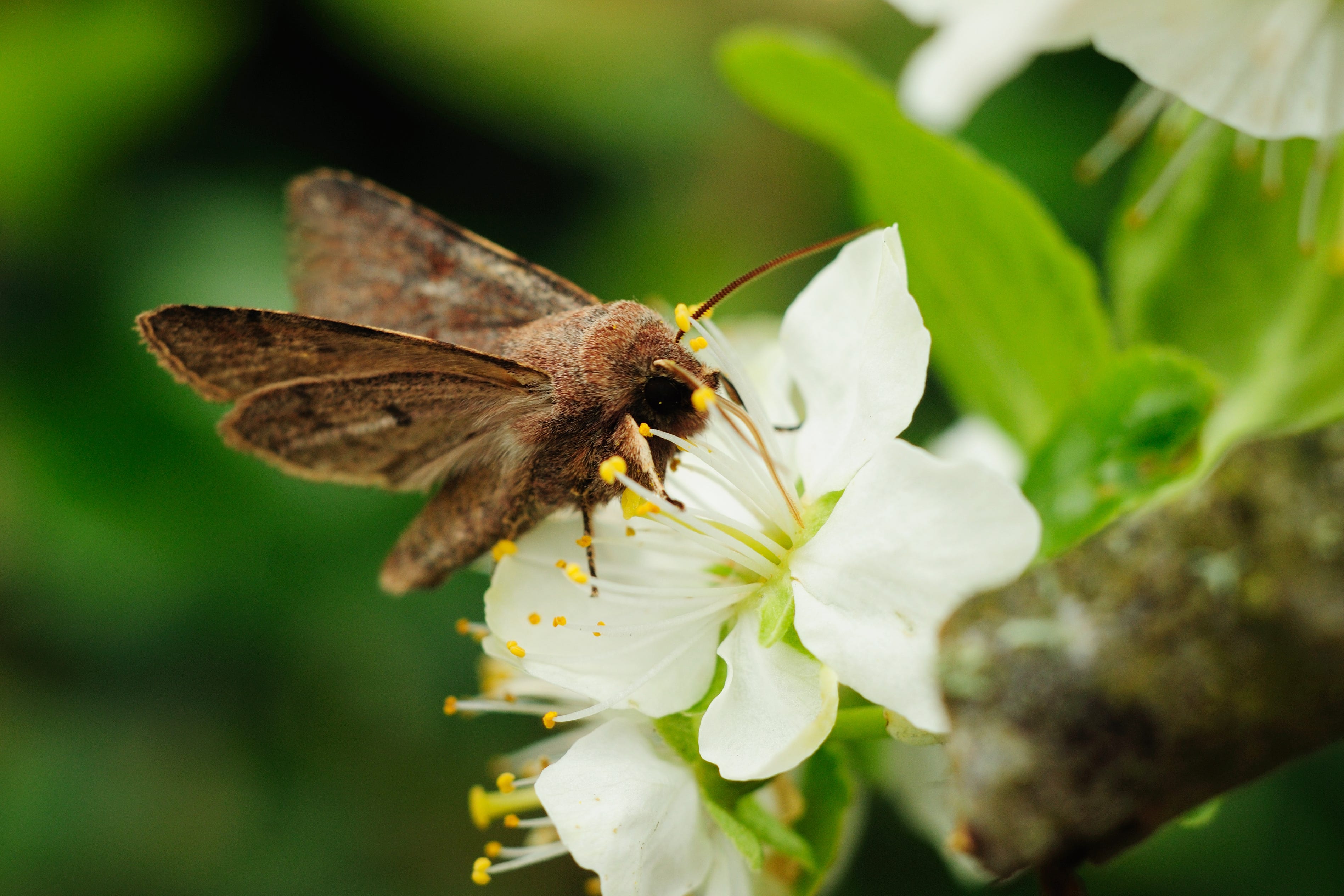
In some cases, the relationship between plant and pollinator is so specialised that a particular species of plant will only be pollinated by one species of moth. In Madagascar, Wallace’s Sphinx Moth (Xanthopan praedicta) has an almost-30cm long proboscis, and is the sole pollinator of an orchid called Angraecum sesquipedale which has an almost-30cm long nectary. The existence of this moth was predicted by both Charles Darwin and Alfred Russell Wallace in the 1860s, after seeing the orchid. They were finally proved right when the moth was observed in 1903, although it was originally described as a subspecies of Morgan’s Sphinx Moth (Xanthopan morganii praedicta) and was not recognised as a full species until as recently as 2021.
Moths and caterpillars are an important food source for many creatures including birds, bats, other small mammals such as shrews, and lizards, spiders, frogs and toads. According to the British Trust for Ornithology (BTO) bluetit chicks can eat up to 100 caterpillars a day, so an adult feeding a brood of ten chicks will need to bring back 1000 caterpillars to the nest each day!
Winter-flying species of moths can be essential for birds at a time when other insect prey is scarce. Nocturnal moths also make up a significant part of the diet of several bat species.
Obviously they don't all get eaten though, so how do they go about avoiding predators? Well, they have a few different techniques.
Moths can hear the sounds produced by hunting bats. Some moths stop flapping their wings when they hear an echolocating bat, and drop suddenly towards the ground to evade capture. Some tiger moths have a different technique to avoid being caught: they can make clicks to "jam" the sonar used by foraging bats.
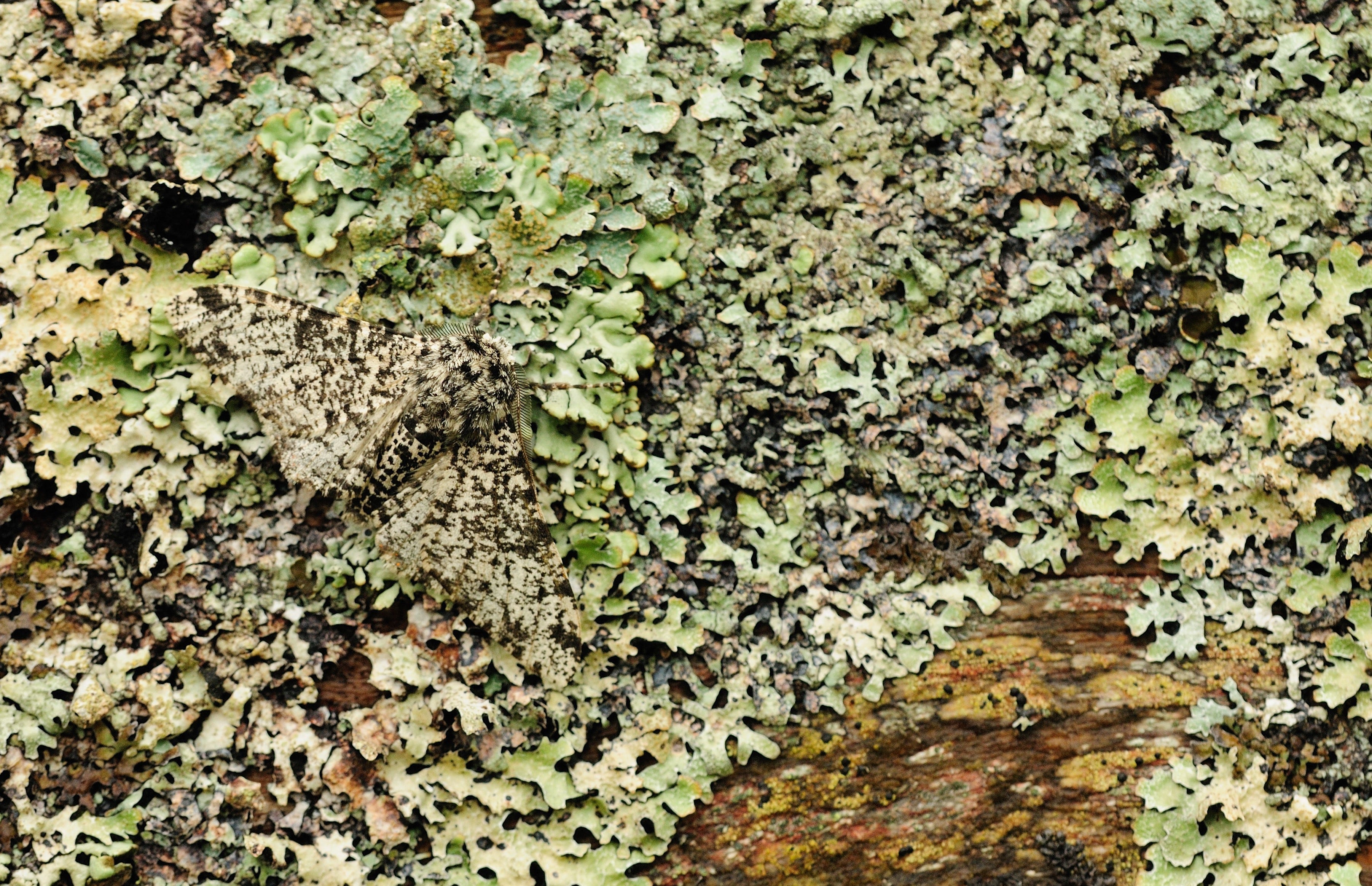
Another technique is camouflage. Many moths spend the day resting on tree trunks and have evolved excellent camouflage, like the Grey Arches (Polia nebulosa) shown here on a birch tree. Also pictured below are a Feathered Thorn (Colotois pennaria) amongst dead leaves, and an Autumn Green Carpet (Chloroclysta miata) camouflaged against lichen.


While we’re on the subject of camouflage, let’s talk briefly about Industrial Melanism. This is an effect observed in several different insect species whereby individuals of a population living in polluted urban areas have evolved to be darker (“melanic”). Industrial Melanism has been observed in over 70 species of moths in the UK, but the most famous example is probably the Peppered Moth (Biston betularia).
The pale 'typica' form of the moth is perfectly camouflaged on a background of mottled lichen, while the dark form 'carbonaria' is better disguised against dirty, soot-covered trees. It became very common in the UK during the industrial revolution when air pollution levels were high, sulphur dioxide killed off lichens, and soot darkened the bark of trees. Apparently, between 1848 and 1895, the population of 'carbonaria' moths in Manchester increased from 0 to 98%! Pale moths have become increasingly common as the air has become cleaner. Because I live in a rural area with low levels of pollution, I only see the 'typica' form.
Other examples of camouflage are the Chinese Character moth (Cilix glaucata) that looks like a bird dropping, and the Buff-tip (Phalera bucephala) that looks like a broken birch twig. I have to admit that the first time I saw a Buff-tip moth, it fooled me! I thought a little bit of stick had fallen into the trap and was about to tip it out of the egggbox, when it moved and opened its wings slightly. I was absolutely amazed, and Buff-tips have been one of my favourites ever since. I always do a “happy dance” when I find one in the trap!
A lot of caterpillars are green, or look like little brown twigs, to avoid detection by predators. Others go to the opposite extreme, and have bright colours to advertise their unpalatability. The caterpillars of the Cinnabar moth (Tyria jacobaeae), for example, feed almost exclusively on Ragwort. Both the leaves and flowers contain toxic alkaloid substances that the caterpillars store in their body, becoming toxic themselves. Their black and yellow stripes act as a warning to potential predators.


There are several easy things you can do to help your local moths, and to attract more of them into your garden. The first of these is the easiest: don’t do anything! Moths, and their butterfly cousins, don’t like things to be too neat and tidy. Those messy corners of your garden - the ones with dead seed heads and piles of leaves and sticks that you haven't got around to sorting out yet - are a great habitat for overwintering moths at different life stages. Caterpillars shelter in hollow stems; eggs laid last year on twigs are waiting to hatch out; pupa rest in soil and leaf litter. A lot of caterpillar food plants are things we tend to class as weeds, such as nettles. Now I’m not suggesting you should turn your entire garden into a giant nettle patch (unless you want to!), but maybe let a little corner go wild... You could grow a variety of native plants to feed moths at both the caterpillar and adult life stages. Having nectar-producing flowering plants available for as much of the year as possible will help early- and late-appearing species. Night-flowering plants are popular with moths too - they tend to have light-coloured or white flowers and a strong scent to attract moths. And of course, step away from the pesticides and insecticides!
Happy mothing everyone,
Cat x
Posts here are always going to be free, but if you like what I write and find it useful, I’ve added a ko-fi button below if you want to show your appreciation.
I love caterpillars, moths, and butterflies, well, all insects, honestly, but caterpillars especially. It was very interesting to read about your moth trapping experience and how things are being monitored on your side of the Atlantic. Thanks for sharing this.
Every time I see a moth I think of you, and I find I actively seek them out more. I found one the other day fluttering around, and once it landed I was able to ID it as a Common Oak Moth. I also have come to appreciate that the ones that look brown and boring often have subtle but intricate patterning on them, if you can see them close enough. Anyway, you know I'm your biggest fan, and I thank you for making moths a bigger part of my life.